OHA’s mission is to improve conditions for Native Hawaiians. What unique skills and/or experiences do you bring to this kuleana to help OHA fulfill its mission?
Born and raised in the 50s urban ghettos of Honolulu, I experienced firsthand the historic social and economic challenges as a Kanaka Maoli Hawaiʻi. Educated in the Territorial public schools, I graduated from Kamehameha. As a retired police officer, I utilized that experience writing grants, curriculum, and reports to help organize community activities and projects. An educator, artist, inventor, and ʻAHO elected delegate, I’ve held numerous leadership and supportive roles in political, economic, social and cultural organizations locally, nationally and internationally, organizing, participating in community meetings, beneficiary initiatives, iwi repatriation, restoring ʻike niu, ʻāina momona, wai and kai, and lāʻau lapaʻau methods that establish food and water security and sovereignty.

What is your understanding of the role of an OHA trustee and their kuleana within the agency and to the lāhui?
The Hawai’i State Constitution 48 years ago created a governing board of nine trustees to set up OHA policy managing the Native Trust ceded lands assets. OHA never received its equity of 20% revenues, causing systemic economic and social inequalities of physical, psychological and spiritual trauma and dislocation within the general population of Hawaiʻi. A semi-autonomous state entity, OHA nation building initiatives of self-determination/governance were abandoned; defaulted on its primary, inherent, and fundamental economic and political sovereign rights for Kānaka to govern our own affairs.
The U.S. Congress Apology Law guaranteed a process of reconciliation with the Native Hawaiian people directly. Studies, findings and recommendations by the DOI, DOJ, and state government task forces created guidelines for implementing steps of reconciliation, hoʻopono. We must huliau, think as beneficiaries, stop living an illusion of reality and assimilation of americanism. Remember, we are the host culture, the native people, not a racial minority; we are houseless, not homeless. We can overcome these social and cultural stigmas through an economic realignment, kuleana waiwai like whereby our Native Trust assets can be invested in a CDFI, a Native Hawaiian Bank, that can overcome this economic/social disenfranchisement towards a better future for all of Hawai‘i.

Share your manaʻo on the military’s use of crown and government lands in Hawaiʻi given the impending expiration of multiple military land leases and the fact that OHA derives an annual pro rata revenue share from the military’s use of those lands.
U.S. military leases of 46,000 acres of Hawaiian land which expire in 2028, but costs Islanders in historical land use, unaddressed toxic legacy of environmental harm and contamination. Native Hawaiians need to decide our future of our ka pae ʻāina o Hawai‘i. “Aloha ʻāina reminds us that land is not a commodity to be exploited but a living relationship to be honored and sustained,” said Vicky Holt Takamine. Keep Hawaiian lands in Hawaiian Hands. E huliau kākou a pau – change we must!
kawaiola.news
Background and Platform:
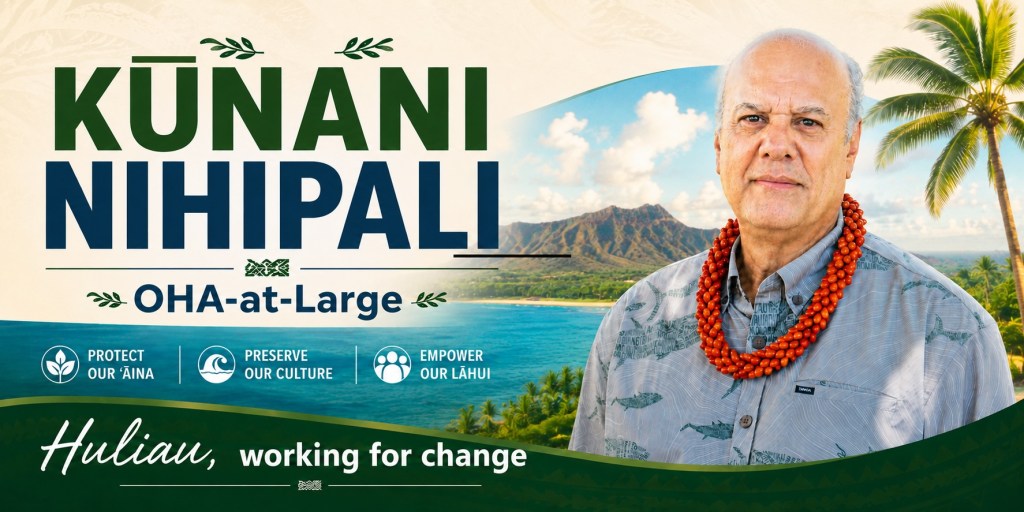
Name: R. Kūnani Nihipali Sr. Age: 76 Occupation: Mahiʻai with Niu Now Molokaʻi; Retired Honolulu Police Officer Where did you grow up: Honolulu, Oʻahu Schooling: DOE public elementary schools, Kamehameha Schools Current residence: Hoʻolehua Homestead, Molokaʻi
Job history As a retired Police Officer, I worked at utilizing that experience writing grants, curriculum, and reports to help organize community activities and projects: as an educator/ artist teaching students in all levels of HI DOE schools resulting in over a dozen murals depicting the past & present history future of its venues; Po'o(Head) of Hui Malama I Na Iwi Kupuna o Hawai'i Nei, responsible for the repatriation of iwi kupuna, funerary & sacred objects under NAGPRA; Project Director for Hui Na'auao a Soverignty Education Project.
I worked voluntarily as a Director/fundraiser/co-creator of the Kue Petitions Peace Memorial Wall; with the POW-Pu'uhonua O Waimanano, A.A.M.A.-Aloha 'Aina Malama 'Aina ahupua'a management, the KWWL Kuleana Waiwai Like, Economic Sovereignty education and CDFI-Native Hawaiian Bank & Financial Literacy projects; Vice-chair of NARF-Native American Rights Fund Investment & Audit committees; BODirector with NHAC-Ke Kia'i Native Hawaiian Advisory Council; BODirector of Pua Foundation as a recipient of the Redress by the UCChurch 1993 Apology to the Native Hawaiians, and with numerous leadership and supportive roles in political, economic, social and cultural organizations locally, nationally and internationally.
Previous elected office, if any Elected delegate with the 'Aha Hawai'i 'Oiwi, AHO for the Ko'olauloa District of Oa'hu to 'propose a form of native governance structure' for Native Hawaiians in 1993
Please describe your qualifications to represent the Native Hawaiian community. Born in the 1950's urban & country areas of Honolulu, I experienced firsthand the history of the economic, social and cultural challenges as a Kanaka Maoli living in the urban ghetto areas and the housing projects.
My whole life has been community service, organizing participation in meetings, forums, presentations, workshops; community & beneficiary awareness initiatives; mahi'ai-farming of sustainable & sustenance food & water security, restoring 'aina momona-plentiful & la'au lapa'au-medicinal to our ka pae 'aina-land, kai-ocean, and wai-fresh waters.
In 1988 we established State Laws to protect na iwi kupuna & wahipana-sacred burial grounds and desecrations in Honokahua; guest artists/lecturer with the KEEP-Kamehameha Schools Extension Education Program in the Hawai'i Corrections facilities; Na Pua No'eau Gifted & Talented Hawaiian Children Program; Ho’ala Hou-ReAwakening workshop of the Hawaiian Home Commission Act Kalamaula-Moloka’i between Native Hawaiians and the Department of Interior-ONHR Hawaii staff on the 125 Amendments to the 1921 HHCAct; as Niu Now Molokai today, we farm subsistence and sustainable foods creating a contemporary uluniu, restoring the culture of 'ike niu-coconut knowledge and the 2025 unprecedented Interim Ruling banning mediation materials to Molokai that may contain the CRB-Coconut Rhinoceros Beetle; Molokai QLCC teaching art to youth and participated with the Kupuna Council of the Molokai Heritage Trust to secure Molokai Ranch Lands for our community.
What is the most pressing issue facing Native Hawaiians, and how would you address it? Economic independence is an essential element of political sovereignty based on the same foundation and legacy we received from our ancestors. Our Native Trusts, pre/post occupation, are valued over $20+Billion. Financial and economic freedom are central to the viability and well-being of our people and ensures access and control of our trust investments, be it fiscal, land, and/or natural resources. We proposed our Kuleana Waiwai Like project to OHA 20+years ago to utilize a Strategic and Cultural path with goals, objectives, values and beliefs between partners/stakeholders and the Kanaka Maoli Hawaii. KWWL is a Realignment Plan intended to assist in leading us from economic dependence to economic independence. It will give us a sense of self-reliance to obtain our full human potential to manage our Native Hawaiian Trusts assets in a manner that empowers us beneficiaries and provide competitive returns that communicates Hawaiian values. My experiences with: Native Hawaiian educational community organizations: Pua Foundation, Hui Na’au’ao, HMINK, POW, committees & boards-NHAC, KWWL, NARF:Investment & Audit, elected officials, agencies, institutions and unions helped enrich my understanding to build community economic capacity as prudent and socially responsible investors. KWWL is a community outreach plan for CDFI development, strategic investment planning workshops, leading to a community empowerment bank to restore our status as stewards of our fiscal & financial future.
What role should OHA have in the U.S. military’s land lease negotiations in Hawaii? U.S. military leases 46,000 acres of Hawaiian land that expires in 2028. OHA should not just be the recipient of historical military land use, its unaddressed toxic legacy of environmental harm & contamination, desecration of sacred and burial lands, but be compensated directly for this mismanagement of our lands. OHA with Native Hawaiians need to decide our future of our ka pae ‘aina o Hawai’i. “Aloha ʻāina reminds us that land is not a commodity to be exploited but a living relationship to be honored and sustained,” said Vicky Holt Takamine.
What more can OHA do to support Native Hawaiian business ownership and entrepreneurship? As OHA Beneficiaries we have a kuleana and social responsibility to rebuild our nation taking a more direct role in the planning, management and investment of our Native Trusts assets that utilizes traditional wisdom, values and beliefs towards Economic Sovereignty. OHA should partner with the DHHL to fulfill its mandate: “to rehabilitate the Native Hawaiian people" by providing housing solutions that includes not only building homes that create sustainable communities, but also improve existing infrastructure, install alternative energy systems, have access to necessary resources, support services, and economic development schemes that create professional employment.
Do you support or oppose the potential purchase by OHA of KITV or another major Hawaii media outlet? Please explain. Media is an important and powerful 'tool' in messaging. OHA needs to support this acquisition, but needs an entity that is independent from 'fixing' content and context of its broadcasts that reflects transparency and accuracy, not left to the 'control' of its funders. Today, we can see how misinformation can be manipulated in a prejudiced manner. OHA should adopt best practices in public communication, ensure regular and open meetings, provide clear, easily accessible information on its activities and finances. This will foster greater trust and engagement with both the Hawaiian community and the broader public.
What do you believe is the best use of OHA’s Kakaako Makai lands? OHA Kaka'ako Maikai lands should be used in creating a Native Hawaiian Contemporary Visual & Performance Arts Center, promoted as a space for Native Hawaiian artists to have workshops, exhibition or galleries spaces with displays whereby residents and visitors can patronize them. Its location would be a venue in line with routes from the Honolulu airport, the City and walking distance from cruise ship docking areas. There should be open markets for farmed products grown there, fresh fish markets utilizing the boat slips, have preparation and eateries of Native Foods, such as a poi factory that be reestablished there. Housing for Kupuna who may want to live in this community and provide resources to the younger population who will work there. Kaka'ako Makai can be a sustainable community with gardening schemes by improvements to existing infrastructure, installing alternative energy systems and access to necessary resources, support services, health and/or home-care facilities for disabled and/or elderly as a ‘natural’ location for economic community development.
What role can OHA play in helping Native Hawaiians cope with Hawaii’s high cost of living? OHA can begin with lobbying to get rid of the 'protectionist' Jones Act initiated over a 100 years ago that has caused the prices of everything to be artificially inflated. OHA should be seeking ways to acquire alternative air and shipping transportation means between Islands. OHA should be supporting economic, social and cultural educational incentives for all generations especially in the health, housing, food and water industries to protect our Islands in times of unpredictable damages costs from sudden catastrophic climate changes, such as the recent Kona Low Storms and the COVID pandemic. OHA should better lobby and protect ALL its natural resources of our Islands from the 'aina, kai, wai and niu, especially those on our Native Trusts Lands. OHA should coordinate better with the DHHL on housing costs and projects.
How much should the state be paying OHA annually for ceded lands, and how can the agency ensure it receives that amount? For 48 years, OHA has never received its mandated 20% fair share of the ceded lands revenues from the 5f Public Lands Trust funds. We must demand that OHA, receives that mandated fair share of revenues. This ongoing shortfall hinders OHA’s ability to fully, effectively and essentially support the Native Hawaiian community as intended. It is crucial for OHA trust obligations, to achieve its mission, that supports the needs and aspirations that promote the wellbeing of our Native Hawaiian communities. Without this equity, OHA’s ability to fulfill its mandate remains compromised. OHA needs to huliau, change to find solutions and support Reconciliation as the umbrella and basis for our political, economic, social and cultural challenges we face today and into the future. There has never been an inventory of our ceded lands done! This needs to huliau. As a State entity, OHA needs to be transparent and accessible for accountability and transparency to its Beneficiaries, the Native Hawaiian people, and for that matter, the general population of Hawai’i to avoid any conflicts of interest.
What will be your top priority if elected? Native Hawaiian, Kanaka Maoli Hawaii thought that OHA, would be a voice for us, but OHA is defaulting on one of its primary reasons it was created in the first place. Till today, OHA has NO Nation Building initiatives for Self-Determination and Self-Governance, both fundamental rights that acknowledges our inherent economic and political sovereignty. As a nation, having autonomy to govern our own affairs, preserve and perpetuate our cultural heritage, make decisions that best serve our community to ensure that we have a rightful place in shaping the future of our homeland. As beneficiaries of OHA, we aren’t asking for anything more than any host culture would, accountability that was established historically to its Beneficiaries, not the governments! “…the department (DHHL) and its policy-making body need to assert more control over its trust responsibilities,” Becky Ashizawa, New Advocate is urged to protect Hawaiian rights, Star-Bulletin, A-3, Thurs, 8/10/89).
Is there anything more that you would like voters to know about you? As a 2026 At-Large OHA Candidate, I question: “Who are we serving?” How do I detach myself knowing there is a need for better understanding of the systemic economic, social inequalities and historic trauma of the physical, psychological and spiritual dislocation amongst Kanaka Maoli within the general population of Hawai’i? How do I move forward and engage our challenges as a Native Hawaiian in this contemporary society of reconciliation knowing that accountability is challenging with the passing of time? Trust must be rebuilt to provide opportunities to achieve peace and foster coexistence between opposing communities. Political obstacles to reconciliation can seem overwhelming, but with positive changes in attitudes, spirit, and relationships, it is attainable to disarm the animosity of past inequities. How do I dismantle a tradition that has given us little to nothing in today’s society? By teaching Aloha! I must confront my disagreements and make the transformation in a collective transition with patience, clarity and courage shifting my center of gravity to huliau. Economic Sovereignty is Key to those who must take the Responsibility to make the Reparations and Restore four generations of institutional cowardice and passiveness of historic injustices in creating a better future for all of Hawaii. Huliau Kakou…Change we Must!
There is a need for better understanding of the systemic economic, social inequalities and historic trauma of the physical, psychological and spiritual dislocation amongst Kanaka Maoli within the general population of Hawai’i. In 1993, the US Congress passed the Apology Law and Sec.1(4)&(5), that guaranteed a process of Reconciliation directly with the Native Hawaiian people to make it right, ho’opono. Numerous studies, reports with findings and recommendations by the Federal DOI, DOJ, State Government Task Forces are set guidelines to implementing the steps of reconciliation will provide opportunities to achieve peace and foster coexistence between opposing communities. Political obstacles to reconciliation can seem overwhelming, but with positive changes in attitudes, spirit, and relationships, it is attainable. People need to huliau-to change their paradigm through a realignment of future aspirations in creating a better future for all of Hawaii.